
Ask most owners what is in their pipeline and they will add up every open deal. Three proposals out, one renewal coming, a hot lead from last week: “about $90,000.”
That number is almost never what lands in the bank. Some deals close smaller, some close later, and some never close at all. If you plan hiring or spending around the full pipeline, you are planning around money that does not exist yet.
There is a simple fix: weight each deal by how likely it is to close.
How a weighted pipeline works
For each open deal, multiply its value by its chance of closing:
Weighted value = deal value × probability of closing
Then add up the weighted values. That total is a far more honest estimate of what the pipeline is really worth.
A worked example
| Deal | Value | Stage | Chance | Weighted |
|---|---|---|---|---|
| Renewal, existing client | $18,000 | Negotiation | 80% | $14,400 |
| New project, referral | $24,000 | Proposal sent | 50% | $12,000 |
| Website lead | $12,500 | Qualified | 25% | $3,125 |
| Cold outreach reply | $36,000 | Lead | 10% | $3,600 |
| Total | $90,500 | $33,125 |
The pipeline looks like $90,500. The weighted forecast says about $33,000. That second number is the one to plan around.
Notice what happened to the biggest deal. At $36,000 it dominates the raw total, but at 10% it adds only $3,600 to the forecast. Big early-stage deals are exciting, and they are also the ones most likely to quietly disappear.
Where the percentages come from
You do not need perfect probabilities. You need consistent ones. The easiest approach is to attach a default chance to each stage:
- Lead (they replied, nothing more): 10%
- Qualified (real need, real budget): 25%
- Proposal sent: 50%
- Negotiation (talking terms): 80%
Then adjust individual deals when you know something the stage does not tell you. A proposal to a client who has bought from you three times is not really a coin flip.
After a few months, check yourself. Of the deals that reached “proposal sent”, how many actually closed? If it was one in three, change 50% to 33%. Your own history beats any rule of thumb.
Add timing, not just value
A deal worth $24,000 that closes in March and one that closes in September are very different things for your cash flow. A good forecast spreads the weighted value across the month each deal is expected to close.
That turns your pipeline into something you can line up against your cash flow forecast: what is likely to come in, and when.
The two habits that keep it honest
1. Update stages when something actually happens. A deal moves forward because the client did something: booked a call, asked for a contract, sent a purchase order. Not because you feel good about it.
2. Watch for deals going quiet. A deal with no contact in two or three weeks is usually not “still in negotiation”. It is drifting. Either follow up this week or lower its chance. Silent deals are the main reason pipelines look healthier than they are.
How Kaimind handles this
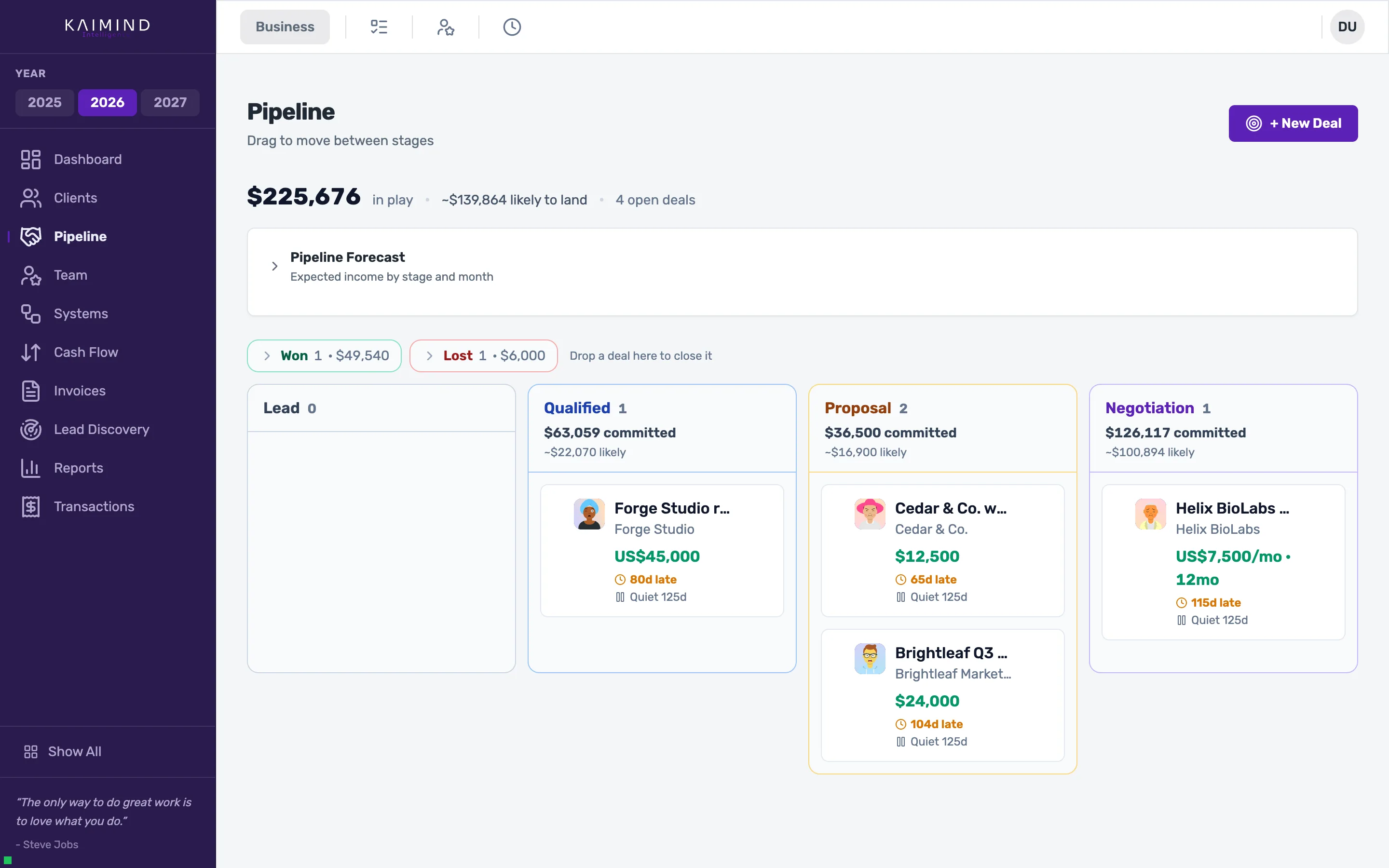
Kaimind’s Deals screen keeps every open deal in a pipeline by stage, with the amount in play and the amount likely to land shown at the top. Its forecast table weights each deal by its probability and spreads it across the months you expect it to close.
Rio, Kaimind’s sales worker, checks your pipeline daily or weekly. Rio flags the next steps that are due, the clients who have gone quiet and the website leads nobody has followed up yet, and drafts a follow-up email for you. Rio never sends anything and never moves a deal on its own. You stay in charge of what goes out and what counts as won.
Start free for 30 days and see what your pipeline is really worth.