
Most small business owners know roughly how much is in the bank today. Far fewer know how much will be there at the end of next month, after payroll, rent, the supplier bill and the two invoices that might or might not get paid on time.
That second number is the closing balance, and it is the most useful line in any cash flow forecast.
What the closing balance is
The maths is simple. For each month:
- start with what is in the bank at the start of the month (the opening balance)
- add everything you expect to come in
- subtract everything you expect to go out
What is left is the closing balance. It then becomes next month’s opening balance, and the calculation rolls forward.
One month on its own tells you very little. Twelve months in a row tell you where the business is heading: building a cushion, holding steady, or sliding toward zero.
Pick your floor first
Before you read a forecast, decide on the lowest bank balance you are comfortable with. Call it your floor.
A common starting point is one month of fixed costs: rent, salaries, software, loan payments, the bills that arrive whether you sell anything or not. Some owners want two or three months. The exact number matters less than having one, because a forecast without a floor is just a list of numbers.
Once you have it, the question for every month becomes simple: does the closing balance stay above my floor?
The three patterns to watch for
When you look across a year of closing balances, almost every problem shows up as one of three shapes.
1. The slow slide. The balance drops a little every month and never recovers. More money is going out than coming in, month after month. It feels fine for a while because each step is small, which is exactly why it is dangerous.
What to do: work out whether it is a revenue problem or a cost problem. Compare this year’s monthly income and expenses with last year’s, or with what you planned. Fix the bigger one first.
2. The single dip. One month drops sharply, then the balance recovers. This is usually one large payment, such as an annual insurance premium, a tax instalment or a big equipment purchase, landing in the same month as a slow stretch of collections.
What to do: move one of the two. Ask the supplier for a later date, split the payment, or chase the invoices due that month harder and earlier. A dip you can see three months ahead is a scheduling problem. A dip you discover the week it happens is a crisis.
3. The staircase down. The balance drops, recovers part of the way, then drops further, again and again. Each recovery is smaller than the drop before it.
What to do: this one is structural. The business needs either more reliable revenue or a lower cost base, and a payment plan will not fix it. Treat it as the most important item on your list.
Find your tightest month
There is one month in every forecast with the lowest closing balance. That is your tightest month, and it deserves more attention than the rest combined.
If your tightest month is still comfortably above your floor, you have room to make decisions: hire, invest, take on a bigger project. If it is close to the floor or below it, that month is where to focus. Everything you do in the months before it, like chasing payments, timing purchases and pushing for deposits, should aim to lift it.
Ask “what if” before you commit
The best use of a forecast is not reading it. It is changing it on purpose to see what happens.
- What if our biggest client pays 30 days late?
- What if we hire someone in March?
- What if the new contract we are pitching comes through in May?
Each of these is a small change to the forecast, and each one moves your tightest month. Run them before you decide, not after.
Keep it current, or it lies to you
A forecast built on last month’s assumptions slowly stops being true. Once a week, take fifteen minutes to:
- mark the money that actually arrived, and the money that did not
- move any payments whose timing changed
- add anything new: a signed client, a surprise bill, a price increase
That short habit is what turns a spreadsheet you made once into a tool you trust.
How Kaimind handles this
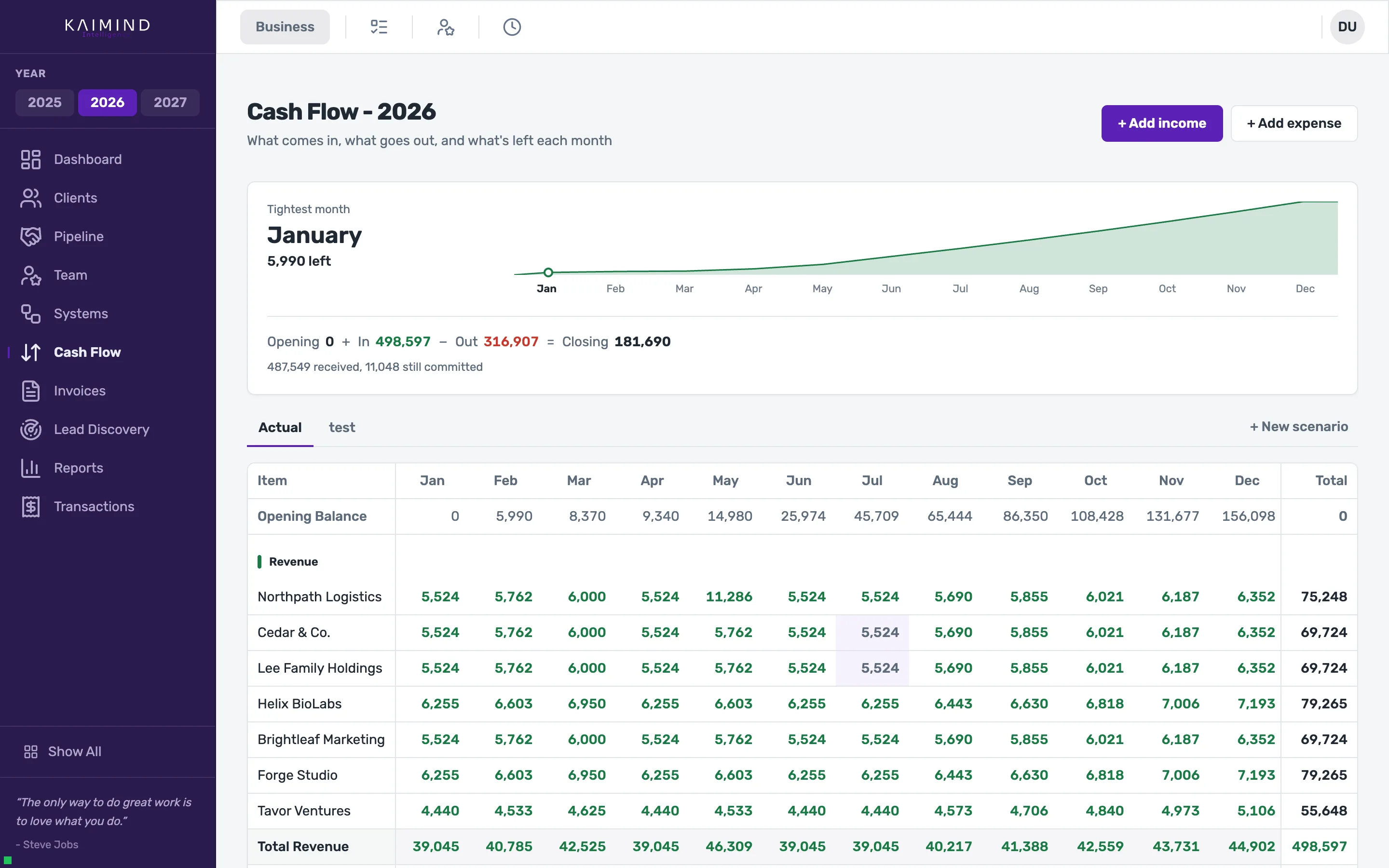
In Kaimind, the Cash Flow screen lays out the year month by month, by client and by expense category. It carries each month’s balance forward automatically and calls out your tightest month at the top, so you do not have to hunt for it.
You can build what-if scenarios, such as a late payer, a new hire or a client you have not signed yet, without touching your real numbers. Compare them side by side, then keep the plan that works.
And because your income, expenses and bank lines already live in Kaimind, the forecast updates as you work rather than waiting for a weekly rebuild. Nova, Kaimind’s reporting worker, can also send you a short summary on a schedule that flags overdue invoices and the payments coming up next.
Start free for 30 days and see your own tightest month in a few minutes.